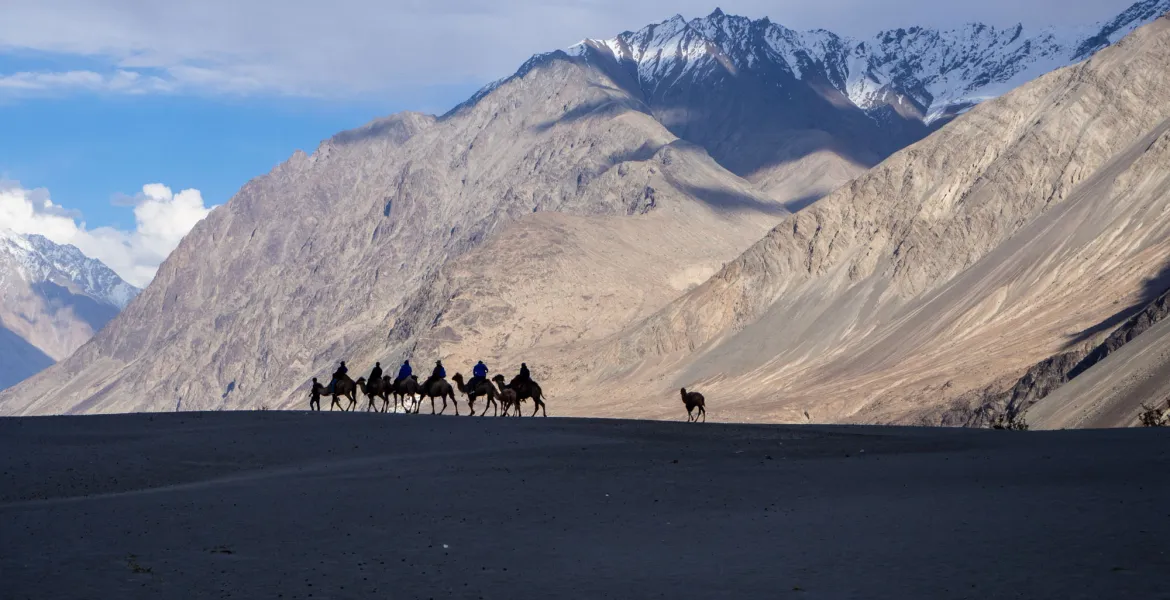
Ladakh is the most beautiful place I’ve ever seen. Located in the far northern corner of the Indian Himalayas, the rugged and remote region is surrounded by snow-capped peaks of the Zanskar, Ladakh and Karakoram ranges. While hilltops are dotted with crumbling ancient monasteries and valley floors are decorated by irrigated green crops and tiny villages.
It’s a region that promises a great adventure, sitting at a lofty 3,500m+. From high altitude lakes, to trekking between remote villages, there’s so many memorable and otherworldly experiences and places to explore in this corner of the world.
I’ve now visited Ladakh twice; spending nearly six weeks each time based in Leh. Based on my own experience, I’ve decided to put together this comprehensive travel guide to Ladakh, with absolutely everything you need to know about travelling to Leh and beyond.
Overview of Ladakh
Ladakh covers the far northern extent of the Indian subcontinent and is bordered by Pakistan to the west and China and Tibet to the north and east. Technically, the broader Ladakh region is also partly in Pakistan, which is known as Gilgit-Baltistan. Together, Ladakh and Gilgit-Baltistan are culturally, ethnically and historically very similar.
Ladakh was part of the former Tibetan Kingdom and is still home to a predominantly Buddhist population today. This means that the culture, language, food, atmosphere and architecture of the region are completely different to what you might find elsewhere in India.
Ladakh was also considered part of Jammu and Kashmir state in India, but since 2019, Ladakh is now a Union Territory.
Leh is the capital and transport hub of the Ladakh region. This is where you’ll want to base yourself when exploring Ladakh. While some people confuse Leh and Ladakh as being the same thing, Leh is the town while Ladakh is the name of the broader region.
When is the Best Time to Travel to Ladakh
High season runs from June to August in Ladakh. This is when the region sees its best weather with warm days and relatively mild nights. The roads are also almost guaranteed to be clear of snow during these summer months, making places easier to access.
If you want to join any tours or treks from Leh, then this is the perfect season to meet other travellers and join groups. Outside of these months it can be hard to find regular departures for tours.
The roads connecting Leh with Manali and Srinagar are usually open from April or May until September or October, depending on conditions. The Leh-Manali Road tends to open later and close earlier due to its higher elevation.
If you’re interested in trekking in the region, try to visit from August up to mid-September. This is when the weather is warm and the trails are cleared of excess snow and ice. High passes and peaks are usually much safer to cross during these months.

How to Get to Leh, Ladakh
Now, this is where the adventure really begins. You can reach Leh, Ladakh by road or by air. Flying is the only option available all year round, while travel by road is possible usually from May until October. There are shared and public transport options by road from either Kashmir or Himachal Pradesh.
By Air
If you’re short on time or aren’t up for many days spent doing long drives on some pretty rough roads, then flying is the better option. There are frequent flights throughout the year from Delhi to Leh. In winter, this is the only way into the region.
Flights are run by Air India, Vistara, SpiceJet, and IndiGo. Flights are around 1.5 hours and cost anywhere from 3000INR (AU$60) to 9000INR (AU$180) one way.

By Road
Undoubtedly, the road trip to get to Leh is one of the best in the world. It’s not for the faint-hearted though as the roads are rough, with steep drops down one side. However, improvements are made each year with large parts of the drive now sealed.
To reach Leh by road, you can come from two directions: Srinagar in Kashmir to the west or Manali in Himachal Pradesh to the south-east. There are public buses, government tourism buses and shared taxis plying these routes during the summer months.
For most travellers, coming from Manali is most convenient and the more popular option, although the road is far more arduous. The Srinagar-Leh road is less travelled but is a great option if you plan to explore Kashmir or think you might have problems with sudden changes in altitude.
The highest point on the Srinagar-Leh route is Fotu La at 4,100m, having a more gradual altitude change up to Leh at 3,500m. Whereas the Manali-Leh road runs at an average height of 4,000m, including three passes over 5,000m, the highest being Tanglang La at 5,320m.
Leave a Reply